
A material decision starts with the board, not the trade name
Circuit Edge Technologies supports PCB layout, hardware development and manufacturing review from Faridabad. This tool turns an early project brief into a material conversation that can be carried into a stackup review. It does not ask you to choose an expensive laminate simply because an interface sounds fast. Start with how the board must move, how its circuits behave and what the supplier can actually build. The result is a family shortlist and a list of unresolved decisions rather than a product approval.
What the selector considers
Enter the project type, rigid or flexible construction, budget preference, heat-removal priority, environment, assessment frequency, critical route length, local operating temperature and requested circuit layers. For an RF board, assessment frequency should describe the relevant carrier or operating band. For a digital board, do not equate a clock frequency with the highest significant spectral content. This selector does not derive edge bandwidth, insertion loss or eye opening. The high-speed branch deliberately asks for a channel review instead of claiming that a particular FR4 family supports a universal data rate.
Why there is no suitability percentage
A numerical fit score would imply a calibration that this tool does not possess. Material properties vary with grade, resin content, glass style, frequency, copper foil and test method. A family name therefore cannot supply a reliable single dielectric constant, loss tangent or operating-temperature rating. The shortlist order is a Circuit Edge engineering discussion priority. Expand the rules beneath the result to see the exact branch that was used. Budget can expose a trade-off, but it cannot silently replace a flexible or RF construction with ordinary rigid FR4.
Rigid control board: keep the first comparison practical
Consider a four-layer industrial controller with ordinary mixed-signal routing, a local operating temperature of 70 °C, normal heat-removal needs and a balanced budget. The default branch starts with general-purpose FR4, then lists high-Tg and lower-loss glass/epoxy as alternatives to discuss if a requirement justifies them. This is not proof that the cheapest available material is adequate. Obtain the actual grade and pressed thickness, confirm the assembly process, and check whether moisture, via reliability or a particular interface creates a stricter requirement.
RF board: distinguish a construction family from a product
Change the project to RF and enter the assessment frequency and important route length. The comparison shifts toward hydrocarbon/ceramic and PTFE-based RF families, with lower-loss glass/epoxy retained as a possible discussion alternative. At 10 GHz the ordering changes as a declared screening rule; it is not a frequency rating of any laminate. Ask the manufacturer whether its process Dk and design Dk have different intended uses. Confirm the final foil, dielectric thickness and stackup with the fabricator, then analyze the real RF geometry.
Flexible and rigid-flex boards: let the mechanics lead
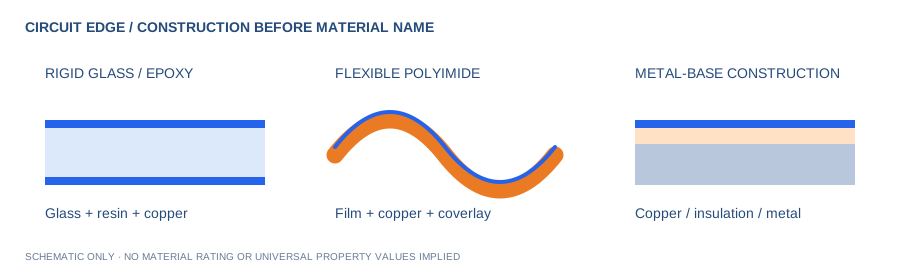
A flexible interconnect requires a flex construction. A rigid-flex assembly requires planned rigid zones, flexible zones and transitions. The selector excludes rigid-only families when either mechanical option is selected, even when a low-cost budget would otherwise favor FR4. That exclusion avoids a misleading result that optimizes a preference while violating the design requirement. Polyimide alone does not establish bend life: copper type, coverlay, adhesives, layer count, local strain and assembly shape still need to be reviewed with a capable supplier.
Power boards: compare the whole heat path
When a modest-layer-count power board is marked as heat-critical, the tool opens an IMS comparison branch. IMS combines circuitry, an insulating dielectric and a metal base, but the complete thermal path still includes the device attachment, dielectric, metal spreading, thermal interface and ambient conditions. The tool does not calculate junction temperature or isolation withstand. More than four requested layers produces a specific caution rather than assuming a standard metal-core stack can support the routing. A ceramic-based substrate may be worth discussing when the assembly and reliability requirements support a specialist process.
Temperature: do not turn Tg into an operating limit
The entered temperature is the intended local service condition, not the laminate glass-transition temperature. A Tg value does not certify long-term operation at that value. High-temperature inputs trigger a closer review of exact-grade evidence, copper adhesion, expansion, moisture history, thermal cycling and applicable service ratings. At 150 °C and above this tool opens a specialist review branch and explicitly states that no candidate is cleared for the temperature. These numerical triggers belong to the screening logic, not to a manufacturer material specification.
Turn the shortlist into a fabricator-ready conversation
Use Copy Material Brief, PDF or CSV to retain the inputs, candidate families, declared rules, trade-offs and questions. The shared link reproduces the inputs; it does not share confidential design files. Before a layout release, record the approved laminate and prepreg construction, pressed dielectric thickness, copper profile and any permitted substitutions. When the supplier proposes a substitute, compare the properties that matter to your particular board rather than accepting an apparently similar family label. Circuit Edge can help connect that discussion with stackup planning, impedance estimates and layout constraints.
What to confirm before buying material
The result is intentionally independent of live stock and pricing. Relative-cost labels are qualitative and depend on supplier, board size, construction, volume and region. Check availability, minimum order constraints and processing capability directly. Humid operation adds moisture and insulation questions; it does not automatically establish a coating solution or a safety rating. Regulated or safety-critical products still need their applicable qualification and compliance process. A material shortlist is one input to that review, not a substitute for evidence.
Plan the layers in the PCB stackup builder. Connect this review with the single-ended impedance workspace, copper-width review and Circuit Edge PCB design services.
Technical background
Product documentation illustrates why exact constructions and test conditions matter. These references support material verification; candidate families still need a supplier-approved grade and stackup.
- Construction-dependent glass/epoxy material data
- RF laminate design and process data
- All-polyimide flex construction documentation
- Insulated metal substrate construction overview
Material selection questions
Does Circuit Edge recommend a specific supplier?
No. This tool compares material families. Exact grades, availability, stackup construction and quotations must be agreed with a supplier.
Why are Dk, Df and Tg not shown as fixed family values?
Those values depend on the actual formulation, construction, frequency and test method. Use the selected product documentation rather than a universal family value.
Can standard FR4 work for a high-speed interface?
That depends on the complete channel and its loss budget, geometry, length and copper profile. The selector prioritizes a comparison instead of inventing a data-rate limit.
Will the tool choose rigid FR4 for a flexible board?
No. Flex and rigid-flex requirements exclude rigid-only candidates. The mechanical requirement is treated as a constraint.
Does high Tg prove a high operating-temperature rating?
No. Continuous service, assembly conditions and thermal cycling need exact-grade evidence. Tg is a material transition measurement, not a universal allowable temperature.
Is the shortlist a compliance or manufacturing approval?
No. It is a transparent rule-based starting point. The material, construction, insulation and product requirements remain subject to engineering and fabricator review.
Can I save the reasoning with my project?
Yes. Copy, PDF and CSV include the project inputs, shortlist, reasoning and review questions. A share link preserves the inputs in the URL.